Studio Notes
Behind the Scenes: Creating a Custom Couture Gown
8 December 2025
Introduction
There is something almost sacred about a gown made entirely for one person. Not a sample pulled from a rack, not a dress altered to fit — but a piece conceived, designed, and constructed from the very first thread with a single woman in mind. That is what custom couture means to me, and it is the heart of everything we do at Molteno Couture.
Every gown that leaves our studio carries with it hundreds of hours of thought, skill, and care. It carries the story of the woman who will wear it — her dreams for the day, the way she moves, the things that make her feel most herself. When I say that no two gowns are alike, I don’t mean it as a marketing phrase. I mean it as a simple, literal truth. Each one is as individual as the person it was made for.
I want to take you behind the scenes today. I want to show you what actually happens between that first conversation and the moment a client steps into her finished gown. Because the process is long, and it is layered, and it is — I believe — one of the most beautiful things I get to be part of.
The Initial Consultation
Every gown begins with a conversation. Not a sales pitch, not a catalogue browse — a real, unhurried conversation. When a client comes to me for the first time, my most important job is simply to listen.
I want to understand the occasion, of course. A wedding gown carries different emotional weight than a matric farewell dress or a gown for a milestone birthday celebration. But beyond the event itself, I want to understand the woman. How does she feel in her body right now? What silhouettes has she always loved? What has she worn in the past that made her feel extraordinary — and what has made her feel invisible? These questions matter enormously, because a couture gown should not just fit the body. It should fit the person.
I also ask about lifestyle and practicality. Will she be dancing all night? Does she need to move freely, sit comfortably, travel in the gown? Is she someone who loves drama and statement, or does she prefer quiet elegance? All of these details shape every decision that follows. The consultation is not a formality — it is the foundation on which the entire gown is built.
Sometimes clients arrive with a very clear vision. They have a Pinterest board, a reference image, a specific detail they have been dreaming about for years. Other times, they arrive with a feeling — a mood, an emotion they want to embody — and together we find the shape of that feeling. Both are equally valid starting points. My role is to translate whatever they bring into something tangible and wearable and deeply, personally theirs.
The Design Process
Once I have a clear sense of who my client is and what she needs, the design process begins. For me, this always starts with sketching. There is something about putting pencil to paper that allows ideas to flow in a way that a screen simply cannot replicate. I sketch quickly at first — loose, gestural lines that capture silhouette and proportion — and then refine as the vision sharpens.
Alongside the sketches, I often build a mood board. This might include fabric swatches, colour references, images of architectural details, nature, art — anything that captures the feeling we are working towards. Mood boards are not about copying; they are about establishing a shared visual language between me and my client, so that when I say ‘soft and romantic’ or ‘structured and powerful,’ we are both imagining the same thing.
Fabric selection begins to happen in parallel with the design work. Sometimes a particular fabric will actually change the direction of the design — a piece of silk organza that catches the light in an unexpected way, or a lace with a motif that feels perfectly aligned with the client’s personality. The design and the material inform each other in an ongoing dialogue, and I find this back-and-forth one of the most creatively exciting parts of the process.
By the end of the design phase, we have a clear direction: a finalised sketch, a fabric selection, and a shared understanding of what we are making together. The client approves the design before we move forward, and I encourage questions and adjustments at this stage. It is far easier to change a line on paper than to unpick a seam in silk.
Fabric Sourcing
The fabric is the soul of the gown. I cannot overstate how much the quality of the material matters — not just to how the finished piece looks, but to how it feels against the skin, how it moves with the body, how it holds its shape over a long day or evening.
I source fabrics from a range of suppliers, both local and international. South Africa has some wonderful textile resources, and I love supporting local suppliers wherever possible. But for certain speciality fabrics — particular weights of French lace, Italian silk charmeuse, Swiss embroidered tulle — I source from overseas, because the quality simply cannot be matched locally. I am unapologetic about this. A couture gown deserves the best possible materials, and I will always prioritise quality over convenience.
Texture and finish are as important as colour and pattern. A matte crepe reads entirely differently from a lustrous satin, even in the same shade. A heavily beaded fabric requires a different internal structure than a lightweight chiffon. I think about how the fabric will behave under studio lighting, in natural daylight, in photographs. I think about how it will feel at the end of a long evening, when the adrenaline has worn off and comfort becomes everything.
When the fabric arrives in the studio, I always spend time with it before cutting. I drape it, hold it up to the light, let it fall over my hand. This is not ceremony — it is information. The fabric tells me things in this moment that will shape how I work with it.
Pattern Drafting & The Toile Fitting
With the design confirmed and the fabric selected, we move into one of the most technically demanding phases of the process: pattern drafting. Every pattern I create is drafted from scratch, based on the client’s individual measurements. I take a comprehensive set of measurements — far more than you would find on a standard size chart — because the human body is wonderfully, endlessly varied, and a couture pattern must account for every nuance.
Before cutting into the final fabric, I construct a toile — a prototype of the gown made in inexpensive calico or muslin. The toile is one of the most important steps in the entire process, and it is one that distinguishes true couture from off-the-rack alterations. It allows us to test the pattern on the actual body before a single centimetre of precious fabric is touched.
The toile fitting is a revealing moment. It is where the design moves from two dimensions into three, and where the reality of the body meets the intention of the sketch. Sometimes everything fits beautifully from the first toile. More often, there are adjustments — a seam moved here, a dart repositioned there, a neckline lowered or raised. These are not failures; they are the process working exactly as it should.
I encourage clients to move freely during the toile fitting. Sit down, walk, raise your arms, take a deep breath. A gown that looks perfect standing still but restricts movement is not a successful gown. The toile fitting is our opportunity to solve every structural problem before it becomes an expensive one.
The Construction
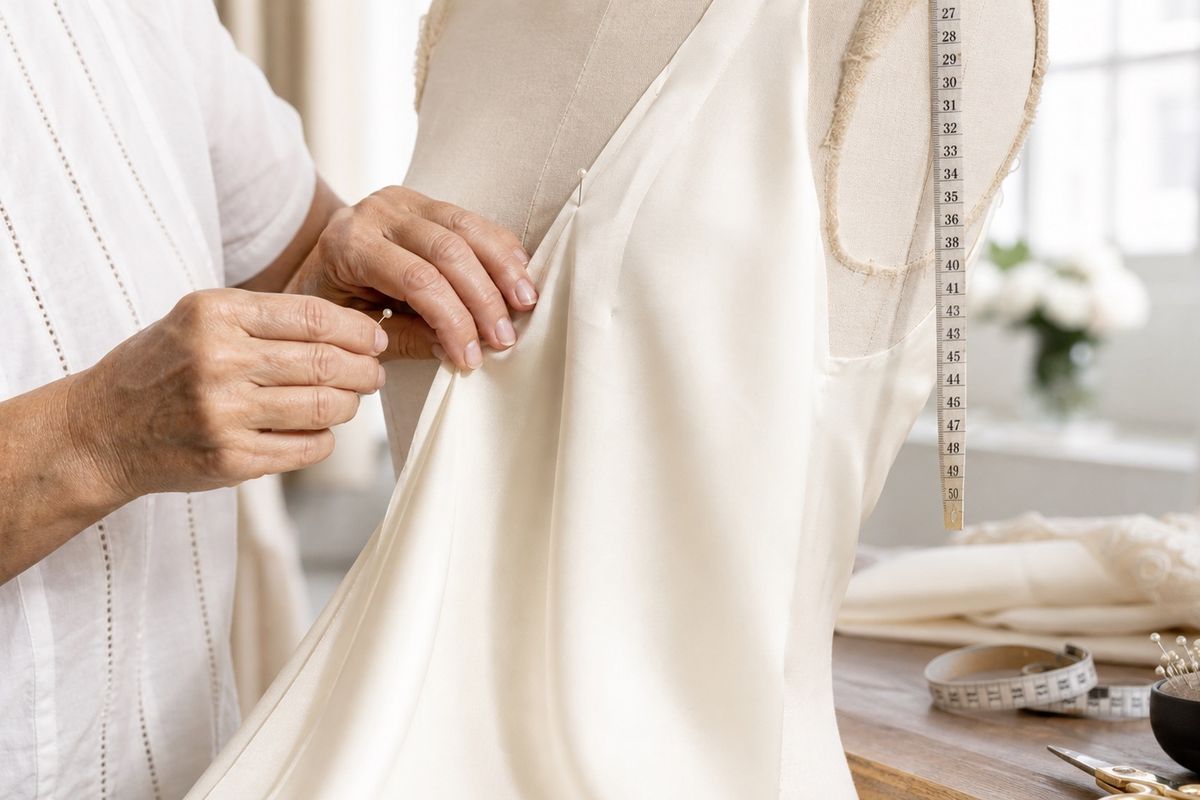
Once the toile is approved and the pattern is finalised, construction begins. This is the phase that most people never see — the long, quiet hours in the studio where the gown slowly comes to life.
Couture construction is fundamentally different from ready-to-wear manufacturing. Many of the techniques I use are hand-worked: hand-stitched hems, hand-sewn boning channels, hand-applied beading and embellishment. These techniques are slower, but they produce results that machine stitching simply cannot replicate. A hand-rolled hem on silk chiffon lies differently — more softly, more naturally — than a machine-stitched one. Hand-sewn beading sits more securely and more beautifully than glued or machine-applied alternatives.
Layering is another invisible art. Most couture gowns have multiple layers — an outer fabric, an interlining, a lining — each chosen for a specific purpose. The interlining might add body and structure; the lining ensures comfort against the skin and protects the outer fabric from perspiration. Boning, where used, is carefully positioned and covered to shape the bodice without creating pressure points.
The hours involved in constructing a couture gown are significant. A relatively simple gown might take sixty to eighty hours of studio time. A heavily embellished or structurally complex piece can take two hundred hours or more. I track my time carefully, not because I am watching the clock, but because I want to be honest with my clients about the labour that goes into their gown. When you hold a couture piece, you are holding someone’s time, skill, and attention. That is worth understanding.
Fittings & Refinements
As construction progresses, we schedule fittings — typically two to three, depending on the complexity of the gown. These are not just check-ins; they are active working sessions where the gown is adjusted, refined, and brought closer to its final form.
The first fitting usually happens when the gown is partially constructed — the main seams are sewn, the structure is in place, but the finishing work has not yet begun. This is when we check the overall fit and silhouette, and make any necessary adjustments before the gown is completed. The second fitting happens closer to completion, when the gown is nearly finished and we are refining the details.
Fittings require patience and honesty from both sides. I need my clients to tell me truthfully how the gown feels — not just how it looks. And I need them to trust me when I suggest an adjustment that might not be immediately obvious to the untrained eye. A seam that appears perfectly straight to a layperson might have a subtle twist that will cause the gown to pull after an hour of wear. These are the things I am looking for.
The final fitting is always an emotional moment. By this point, the gown is complete, and the client sees herself — truly sees herself — in the finished piece for the first time. I have witnessed tears of joy, gasps of surprise, long silences of quiet wonder. These moments are why I do this work.
The Final Reveal
Delivering a finished gown is one of my favourite parts of this entire journey. There is a particular kind of joy in handing over something that did not exist six or eight or twelve weeks ago — something that was conjured from conversation and sketch and fabric and hours of careful work.
I always deliver gowns in person where possible. I want to be there when the client puts it on for the last time before the occasion. I want to see how she carries herself in it, whether she needs any last-minute adjustments, whether she feels the way we hoped she would feel. This final appointment is also an opportunity for me to share care instructions and answer any questions about wearing and preserving the gown.
What strikes me most, every time, is the transformation that happens when a woman puts on a gown that was made entirely for her. It is not just about the fit, though the fit is extraordinary. It is something deeper — a sense of being truly seen, of having been listened to and understood. The gown reflects her back to herself in a way that nothing off a rack ever could.
These moments stay with me. Long after the occasion has passed, I remember the women who have worn our gowns — the bride who cried when she saw herself in her finished dress, the young woman heading to her matric dance who stood a little taller the moment she put it on. These are the stories that live in the walls of this studio.
Why Custom Couture Is Worth It
I know that custom couture is an investment. It requires time, patience, and a financial commitment that is greater than buying off the rack. I would never pretend otherwise. But I also believe, with complete conviction, that for the right occasion and the right person, it is one of the most worthwhile investments you can make.
A couture gown is not a product. It is a collaboration, a relationship, a piece of wearable art that was made with you — and only you — in mind. It will fit your body as no other garment ever has. It will reflect your personality, your taste, your vision. And it will last, if cared for properly, for decades — a tangible memory of one of the most significant moments of your life.
Beyond the practical and aesthetic arguments, there is something profoundly meaningful about choosing to invest in craft. When you commission a couture gown from Molteno Couture, you are supporting a small, independent studio. You are choosing skill over speed, quality over quantity, the handmade over the mass-produced. In a world that increasingly values convenience above all else, that choice matters.
If you have been dreaming about a gown that is truly, completely yours — for your wedding, your matric farewell, a special occasion, or simply because you deserve something extraordinary — I would love to hear from you. Come and have a conversation. Bring your ideas, your inspiration, your questions. Let’s find out what we can create together.